
Football's $41 Billion Economy: The Hidden Business Behind the 2026 FIFA World Cup

A few days ago, in Mexico City, a referee blew a whistle, the world stopped blinking, the crowd started humming, and $41 billion started moving.
Football unites the world; it also moves economies. The 2026 FIFA World Cup is estimated to generate $41 billions of Global GDP.
Just like that, when the greatest show on earth kicks off, the impact extends far beyond the pitch.
Did you know, if sports were a country, it would be the 12th largest by GDP? So, what are the economic impacts of FIFA WC 2026? Which sector will benefit? Will the projected economic benefits materialise? What does history and data say?
Let’s unfold the facts behind the quadrennial show.
The Biggest World Cup in History
The 2026 FIFA World Cup is unlike any before.
For the first time, 48 teams will compete, up from 32 before. That means 104 matches across 39 days, replacing the familiar 64-match format that had defined the tournament since 1998. More games. More nations. More money in motion.
Three countries are hosting simultaneously. The United States, Canada, and Mexico, across 16 cities and two time zones. The U.S. takes the lion’s share. 11 venues, every match from the quarterfinals onwards, and the final at MetLife Stadium in New Jersey. Mexico and Canada host 13 matches each.
You see, the last time FIFA expanded the field, in 1998, global football was a different business. Streaming didn’t exist. Sports betting was largely illegal in the U.S.
Now, the expansion unlocks commercial territory that previous editions couldn’t access. More matches mean more broadcast slots, more sponsorship inventory, and more ticketing revenue.
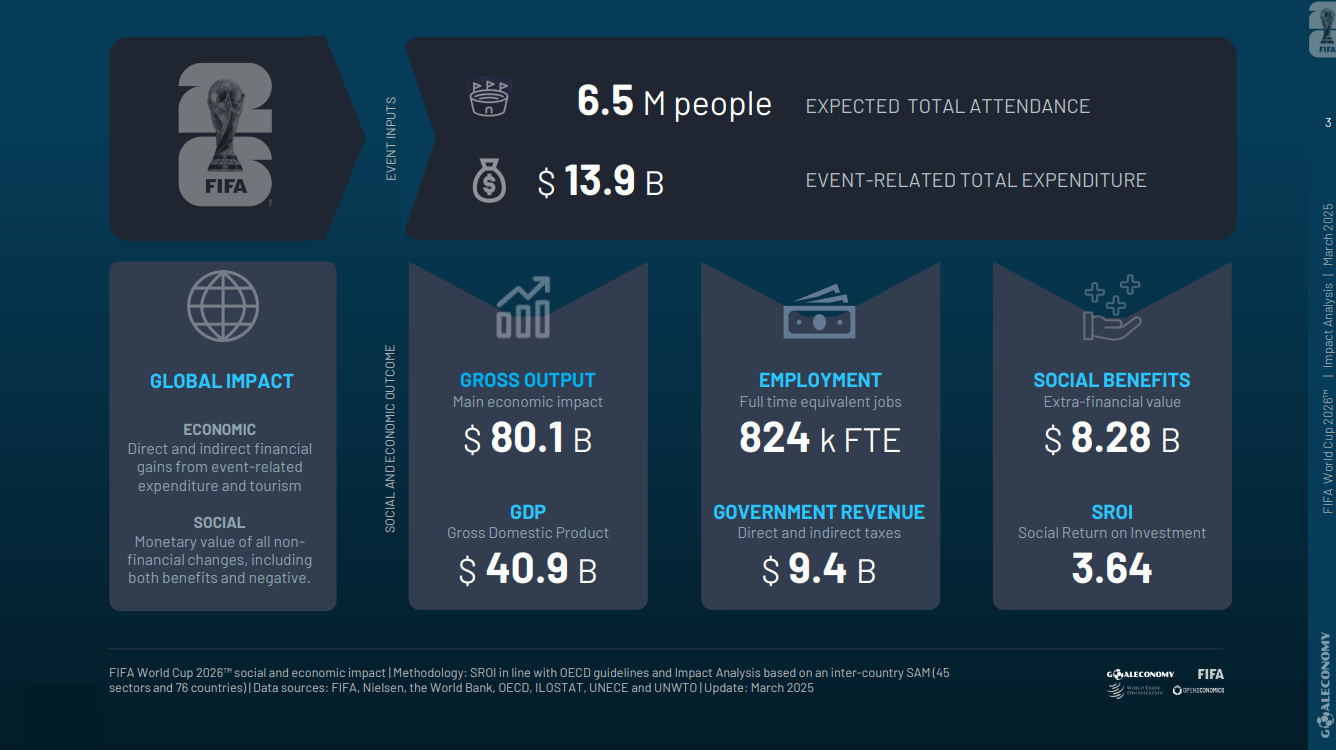
According to FIFA, this time, the world cup will create $80.1 billion gross outputs globally, and 8,24,000 full-time equivalent jobs.
Sports Economy: The Wealth League
Sports is no longer just entertainment. It is an economy.
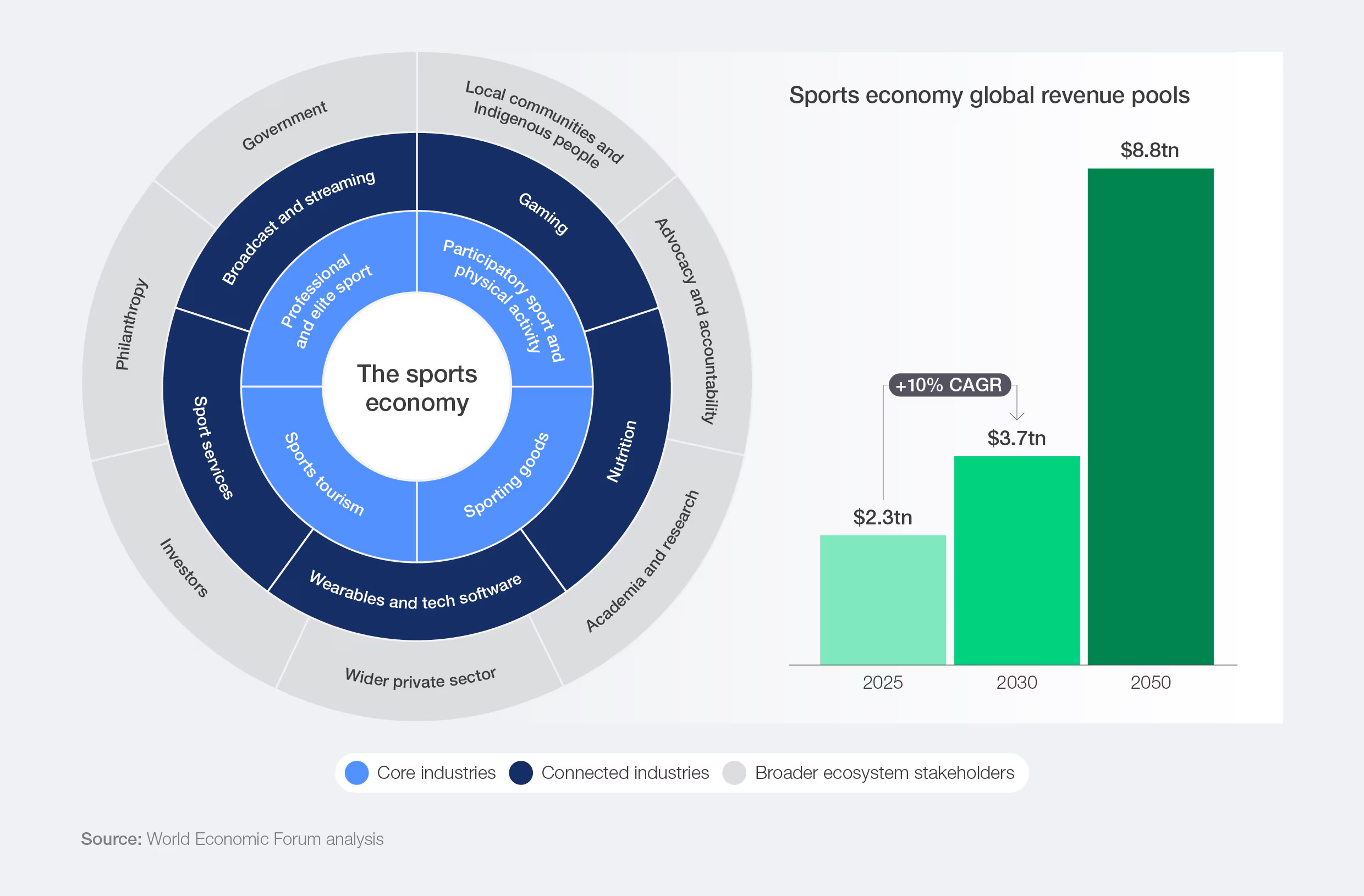
Globally, the sports industry generates $2.3 trillion in annual revenues - roughly 2% of world GDP. To put that in perspective: if sports were a country, it would rank among the 12 largest economies on earth. Bigger than Canada. Even bigger than Australia.
And it is still growing.
The World Economic Forum projects the sports economy will reach $8.8 trillion by 2050. This could be driven by media rights inflation, the explosion of sports betting markets, private equity flowing into clubs and leagues, and a billion-plus new middle-class consumers in Asia and Africa tuning in for the first time.
The World Cup sits at the top of this pyramid. It is the single most-watched sporting event on the planet. 1.5 billion people watched the 2022 final alone. Every four years, it functions as a stress test for the entire sports economy: how much can one event move?
In 2026, we are about to find out.
The Winner Sectors
$3.8 billion. That is what FIFA plans to spend running this tournament. This is on teams, venues, operations, prize money, and marketing. Every dollar of that expenditure travels through an economy. It does not disappear at the final whistle.
But which are the sectors that benefit from the world’s football obsession?
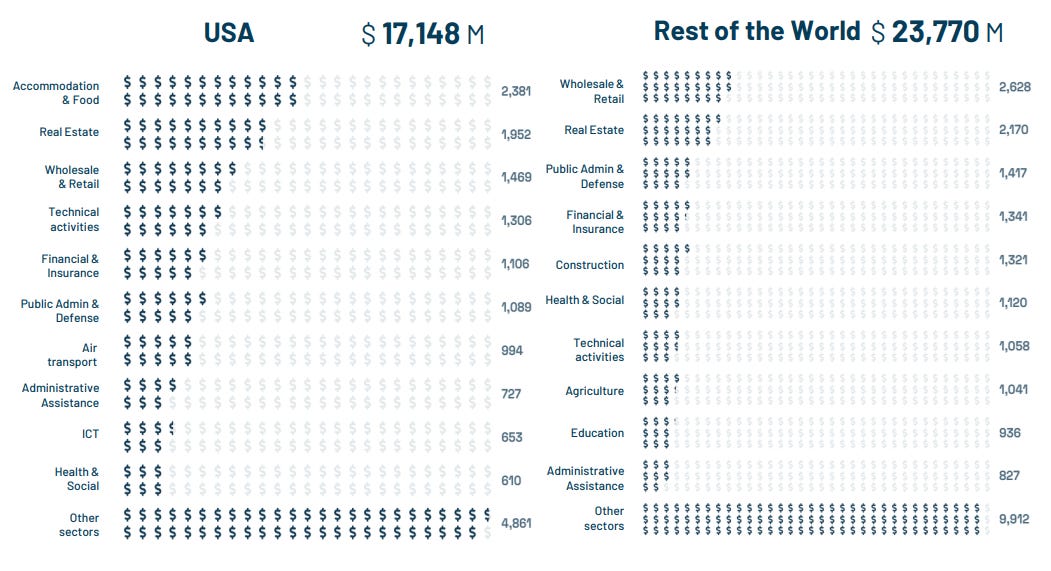
Well, as per FIFA estimations, in the U.S. with $2.4 billion in value added, the biggest winner is accommodation and Food. Real estate captures $1.95 billion. Wholesale and retail takes $1.5 billion.
In the U.S. even beer companies are placing huge bets on the World Cup. According to a New York Times report, beer companies are spending tens of millions of dollars on sponsorships and advertising deals ahead of the curtain raiser.
The ripple travels beyond the host nations too. In advanced and developing economies worldwide, wholesale and retail absorbs $2.6 billion in impact. Real estate follows at $2.3 billion.
Then there are the jobs.
This World Cup is expected to create 823,474 full-time equivalent jobs worldwide. The U.S. will account for 184,679 of these jobs. The other 638,796 will come from countries that provide goods, services, and logistics for the event from afar. In the host nations, most jobs will come from accommodation, followed by air transport and technical activities. In other countries, wholesale and retail will lead in job creation.
The Most Expensive World Cup Ever?
However, these projections got lost in translation. According to news reports, U.S. hotels and airlines have not experienced the expected rise in business. Hotel bookings in several host cities have stayed low, prompting some hotels to lower their room rates. Andy Milne, England superfan and author of the book ‘That World Cup Guy’ told Reuters that his friends are heading to Ibiza instead, watching every match on TV for a fraction of the cost. “Others are going to Vegas,” Milne said. “It’ll still cost money, but far less than tickets, travel, hotels and transport to the stadiums.”
High ticket prices, costly travel expenses, visa issues, and logistical problems are the reasons why international fans are not coming. According to Bloomberg, some fans decided not to attend the world cup because of Trump administration’s anti-immigration policies.
Interestingly, the demand has shifted to somewhere else. And the winner? Short term rentals. The Airbnb bookings across host cities are going strong. In some locations, rental prices have risen sharply as fans opt for more flexible accommodation options over traditional hotels.
The ticket prices for this world cup were also pushing past the halfway line. This is the first time that FIFA introduced dynamic ticket pricing. The high demand for tickets pushed the prices up. The ticket to Metlife Stadium from New Jersey Transit is $98 now; a trip that usually costs just about $13.
The First AI World Cup
In an era where everything is AI, how can we imagine not hearing about the role of AI in the most watched sport in the world?
The technology infrastructure underpinning this tournament is unlike anything previous editions deployed, and the investment flows reflect that.
Lenovo, FIFA’s official technology partner, has built Football AI Pro, a generative AI tool that analyses hundreds of millions of football data points, both historical and real-time, delivering tactical insights to coaches and support staff via text, video, graphs, and 3D visualisations. Every participating team has access to it. Google has struck AI partnerships with eight national squads, including the U.S., Argentina, Brazil, and France, using the tournament as a live showcase for its AI search and mapping capabilities. Salesforce’s Slack is coordinating workforce management across all host cities. Verizon is providing stadium connectivity. RapidSOS is connecting data from over 723 million devices to emergency responders, with AI translation handling the surge of non-English-speaking fans.
Sportradar, which provides data services to sports betting companies, expects up to $50 billion in total betting turnover during the tournament, and is using AI and machine learning to flag suspicious patterns that may indicate match-fixing.
The signal for investors is broader than football. Every company integrating AI into this tournament is using the world’s most-watched event as a stress test.
World Cup: The GDP Boost Assist
Between 1994 and 2014, host nations saw their GDP grow by an average of 0.4 percentage points following each World Cup, according to Bank of America research.
The boost is real when a tournament leaves lasting infrastructure, stronger tourism branding, and improved connectivity behind. It fades when spending is concentrated on security arrangements and temporary facilities that serve no purpose after the final whistle.
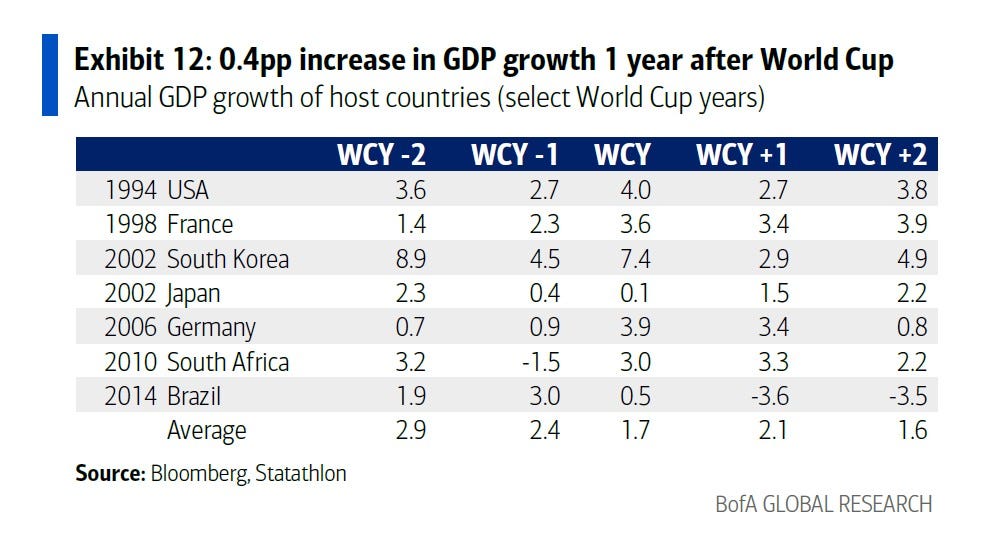
Not just that. Sporting events have acted as a catalyst for long-term economic growth in the past. When the host gets the formula right.
Several cities flourished post the events. For example, the 2022 Qatar World Cup.
Qatar did. The 2022 World Cup generated near-term contributions of up to 1% of GDP from visitor spending and broadcasting revenue alone. But the bigger story was what came before. A decade of infrastructure investment that drove sustained growth in Qatar’s non-hydrocarbon economy. The event also created regional spillovers, with a significant share of spectators staying in and commuting from neighbouring GCC countries rather than Qatar itself.
Brazil’s 2014 edition told a similar story. The tournament injected an estimated $15 billion into the Brazilian economy and generated thousands of jobs, a short-term jolt that fed into longer-term visibility for the country as a destination.
And this is not just a World Cup phenomenon.
In 1992, Barcelona hosted the Olympics. Unemployment in the city fell from 18.4% to 9.6% in the years that followed, a transformation driven by infrastructure upgrades, tourism inflows, and the global rebranding of a city that had been largely invisible on the international stage.
A decade later, Manchester hosted the 2002 Commonwealth Games. The event generated an estimated £1.1 billion economic boost and became a catalyst for the long-term urban regeneration of East Manchester, an area that had been in industrial decline for years.
Hanging Up The Boots
Every four years, the world unites for football. Not just to watch and enjoy the moments. But to spend, to build, to bet, and to invest. Stadiums fill. Beer companies pour billions into 30-second ads. Cities reimagine themselves around a tournament that lasts 39 days.
The 2026 World Cup is the largest edition in history. But what it represents is bigger than the sport. It is proof that football—chaotic, unpredictable, and utterly human—has become the world’s most reliable economic event.
No earnings call. No IPO. No policy announcement moves the world quite like a football tournament.
Once every four years, the beautiful game becomes the biggest asset class on earth.
Disclaimer:
This article is for informational and educational purposes only. It does not constitute financial, investment, or trading advice and should not be relied upon as such. There is no guarantee of any investment gains, and readers are encouraged to conduct their own research before making any investment decisions.